The world of website building is changing rapidly. Companies like Wix and WordPress are using new technologies. They are changing the way we create a digital presence.
Digital automation is becoming a part of everyday life. Developers and business owners in Israel use it regularly.
AI in web development is no longer considered science fiction. Israeli companies like Monday.com and Taboola are using machine learning. They are significantly improving their products.
Innovation in website building allows for the creation of complex websites in a short time. Instead of weeks, it is done in minutes.
Gartner research shows that 70% of companies in Israel use AI. The Israeli market is adopting smart technologies at a rapid pace.
Digital automation is impacting the job market. Developers who use AI earn 25% more.
Companies like Microsoft and Google are investing billions in developing new tools.
Key points
- Leading Israeli companies are adopting AI at a rapid pace
- Save up to 80% on website development time
- Improving the user experience through machine learning
- Increasing demand for developers with knowledge of AI tools
- Automate repetitive and boring tasks
- Creating personalized websites for each user
What is artificial intelligence and how is it changing the digital world?
Artificial intelligence is a powerful force in the digital age.
It is changing the way we interact with computers. Machines can now perform complex tasks that previously required human intelligence.
Definition and basic concepts in artificial intelligence
Artificial intelligence is a field of computer science that deals with developing systems that can learn and make decisions. Machine learning allows computers to recognize patterns in data and improve their performance.
The development of technology in recent years
Between 2018 and 2024, the field experienced a leap forward. OpenAI developed the GPT series, starting with GPT-1 and progressing to ChatGPT.
Anthropic created Claude, and these models demonstrate the power of natural language processing .
The ability to analyze big data on a massive scale has led to significant breakthroughs.
Key applications in the digital field
Giant companies are leading the revolution. Google uses machine learning in Google Search and Google Photos to recognize images.
Microsoft has integrated Copilot into Office 365, and Amazon is running neural networks in Alexa and AWS.
Natural language processing enables instant translation and automated customer service. Big data analytics helps companies understand their customers better and provide personalized services.
The impact of artificial intelligence on the world of website development
Artificial intelligence is changing the way we think about creating websites. Gartner research shows that by 2025, 80% of development will use AI. This will change the face of the digital world.
Companies like Wix and WordPress are already using AI. Wix ADI lets you create customized websites in minutes. WordPress uses Gutenberg AI to streamline editing processes.
Smart adaptive design is now commonplace. AI systems analyze user behavior. Development times are lower, and projects are completed in weeks.
The key change is in code automation. Developers can focus on strategy and innovation. The technology automatically detects bugs and optimizes.
The result is faster, more accessible websites. Machine learning and natural language processing offer a superior user experience.
Advanced AI tools for website design and development
The world of websites is changing rapidly with the introduction of new AI tools.
New tools allow developers to create impressive websites in a short time. These technologies offer possibilities that did not exist before.
Automatic code generators
GitHub Copilot has revolutionized the world of programming. It offers intelligent and accurate code completion. Developers report saving up to 40% in development time.
Tabnine offers similar capabilities with support for diverse programming languages.
Smart graphic design tools
DALL-E and Midjourney are leading the field of AI-powered image creation.
Designers can create original graphics in seconds. Adobe Firefly integrates seamlessly with familiar Adobe tools.
AI-based website building platforms
Webflow integrates AI technologies to automatically create responsive websites.
Framer AI enables rapid construction of advanced user interfaces. Wix ADI builds entire websites based on answers to a few simple questions.
Bookmark AI creates custom websites in minutes.
| platform | Average construction time | Level of customization |
|---|---|---|
| Webflow | 2-4 hours | Very high |
| Framer AI | 1-3 hours | High |
| Wix ADI | 5-10 minutes | Medium |
Automatic performance optimization
Cloudflare analyzes website performance and makes automatic improvements.
The tool identifies bottlenecks and offers immediate solutions. Loading speed is significantly improved without manual effort.
Automation of development and programming processes
The development world is changing dramatically with the arrival of artificial intelligence.
Developers around the world are managing to reduce development time and improve product quality.
The new technology allows teams to focus on creativity, instead of manual work.

Platforms like Jenkins and GitLab incorporate artificial intelligence.
They speed up the deployment process. The systems learn from previous work patterns and offer optimizations for development.
Smart DevOps teams use these tools. They manage hundreds of deployments a day reliably and securely.
| Automation tools | Key advantage | Time saving |
|---|---|---|
| Jenkins with AI | Smart deployment management | 35% |
| GitLab Auto DevOps | Continuous integration | 40% |
| Testim | Automated tests | 50% |
| Applitools | Visual inspections | 45% |
Automated testing has become an integral part of the development process. Tools like Testim and Applitools use machine learning. They identify bugs and issues at an early stage.
The technology allows for clean code to be maintained. It ensures that any code changes are thoroughly tested before deployment.
“McKinsey research shows that organizations that adopt intelligent automation in development processes save up to 40% in overall development time”
The benefits of automation in development processes are clearly visible in business results.
Teams that implement clean code and smart DevOps processes report a significant reduction in the number of bugs in production.
The move to full automation of testing and deployment processes allows developers to focus on innovation and developing new features.
Personalized user experience through AI
Artificial intelligence technologies make it possible to create a unique browsing experience for each user.
Advanced personalization is becoming an essential tool in web design. Ecommerce sites that use these technologies earn 35% more in conversions.
Dynamic content adaptation
AI systems analyze user behavior in real time. They adapt content accordingly.
Dynamic UX allows changes to the site according to user preferences.
Netflix and Spotify have proven the effectiveness of the method.
They use recommendation systems that increase dwell time by 40%.
Machine learning-based recommendations
Smart algorithms learn from user preferences.
They generate smart recommendations for products and services. The system identifies consumption patterns and offers relevant content.
| Recommendation type | Average accuracy | Improvement in conversions |
|---|---|---|
| Similar products | 78% | 22% |
| Customized content | 85% | 35% |
| History-based suggestions | 92% | 41% |
Smart conversational interfaces and chatbots
GPT chatbot and platforms like Intercom and Drift provide instant support.
Bots understand natural language and solve complex problems. The combination of natural language processing enables human-like and natural conversation with users .
Improving accessibility and browsing experience for all users
Artificial intelligence allows websites to be accessible to everyone.
New technologies scan websites and identify accessibility issues .
They fix them with the click of a button and ensure compliance with WCAG standards.
Automatic detection of accessibility issues
Systems like AccessiBe scan the site and detect barriers.
They check color contrast, image alt tags, and title order. The scan is completed in seconds and provides a detailed report of all issues.

Automatic accommodations for people with disabilities
The technology creates personalized accessibility profiles . Users with visual impairments receive text magnification and screen narration.
People with motor disabilities get full keyboard navigation. All adjustments are made in real time without the need for special programming.
Smart translation and localization
Advanced machine translation makes websites multilingual. Deep learning systems translate content while preserving context and meaning.
The technology recognizes local expressions and adapts them to the target culture. Site updates are instantly translated into all supported languages.
The Equal Rights for People with Disabilities Law in Israel requires full digital accessibility .
AI tools help businesses comply with legal requirements with ease. They save time and resources while improving the experience for all users.
Search engine optimization with artificial intelligence
Artificial intelligence is changing the face of SEO. Search engines today use advanced technologies. They provide more relevant results to users.
Google’s RankBrain is an example of AI integration. The system processes billions of queries. It learns to understand relationships between keywords and content.
BERT understands natural language better. The technology allows Google to understand the context of sentences. The result is more accurate ranking of quality content that meets users’ needs.
Tools like Surfer SEO and Clearscope leverage artificial intelligence. They analyze thousands of top pages. Accurate recommendations improve results.
Studies show that businesses that use these tools see a 50% increase in their organic traffic.
The use of smart keywords has become more complex. But more effective. Artificial intelligence identifies related topics and broad semantics.
Real-time data and performance analysis
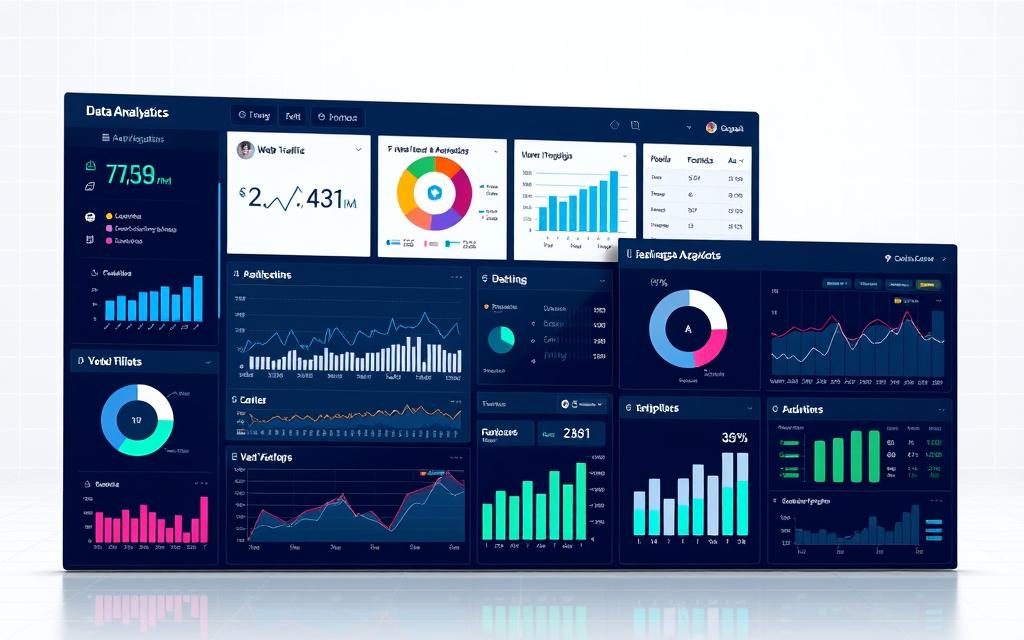
In the digital age, real-time data analysis is very important.
Artificial intelligence tools allow us to understand users at a deep level. Advanced platforms incorporate smart BI capabilities to provide instant insights.
User behavior tracking
Tools like Google Analytics 4 offer advanced tracking capabilities. They automatically identify behavioral patterns.
Hotjar adds a visual layer with heatmaps and session logs.
Automated reports and insights
The artificial intelligence in Google Analytics 4 creates personalized reports.
The system is continuously updated. Predictive analysis allows you to see not only what happened, but also what is expected to happen.
Forecasting future trends and needs
Smart BI technologies analyze historical data and identify future trends. Smart models can predict when a user is about to abandon a site. Hotjar integrates with other predictive analytics tools to create a complete picture of the future user experience.
Information security and advanced threat detection
In the digital age, website security has become more important. Cyber AI provides intelligent defense that learns and evolves. It analyzes millions of threats every day and identifies new attack patterns in real time.
Cloudflare and Akamai’s intelligent WAF systems use machine learning. They automatically block threats. They analyze incoming traffic and identify suspicious behavior before any damage is done.
The effectiveness of proactive security is proven by numbers. According to IBM Security, websites with AI protection have seen a 70% reduction in breaches. The systems identify and prevent threats before they materialize.
| Threat type | Detection time without AI | Detection time with AI |
|---|---|---|
| DDoS attack | 5-10 minutes | 3-15 seconds |
| Phishing attempt | Hours to days | Instant identification |
| SQL injection | 20-30 minutes | Less than a minute |
The integration of AI technologies into website security creates a multi-layered protective envelope. The systems learn from each attack attempt and improve automatically. This ensures a high level of security over time.
Advantages and disadvantages of using AI in website building
Artificial intelligence technologies offer exciting opportunities for the world of websites. Many businesses are finding that investing in smart tools pays off quickly. It’s important to look at the big picture before making decisions.
Saving time and costs
Studies show that AI tools reduce development costs by 30-40 percent. Automated code generation saves many hours of work. Graphic designs are created in minutes instead of days.
Smaller development teams are able to achieve impressive results.
Improving quality and accuracy
Smart algorithms detect bugs before they become a problem. Automated testing ensures cross-browser compatibility. Performance optimization is performed with extreme precision.

Technological challenges and limitations
Implementation challenges arise when customer requirements are too unique. AI systems depend on high-quality data to function optimally. Complex personalization still requires significant human involvement . The initial cost of implementation can be daunting for small businesses.
Preserving human creativity
Human-machine balance is critical to the success of the project. Designers and developers bring emotional value and innovation that machines cannot imitate. The brand story and emotional connection to customers remain in the human domain.
“Technology should serve human vision, not replace it”
Future trends in artificial intelligence and web development
The world of websites is about to change dramatically soon. New technologies like GPT-5 will allow for the creation of websites that can evolve and change themselves. The future promises a fascinating connection between artificial intelligence and advanced technologies, which will change the way we experience the web.
New technologies on the horizon
The next generation of language models like GPT-5 is expected to come with impressive capabilities. The new models will be able to write complex code, design interfaces, and build entire websites autonomously. Web3 brings with it greater decentralization and control for users, as websites will run on blockchain and enable secure and direct interactions.
Combining augmented reality and virtual reality
WebXR technology enables AR/VR integration directly in browsers. Users will be able to try on products in 3D, tour virtual spaces, and experience the metaverse through the website. Fashion stores will offer virtual fitting, and real estate websites will allow for comprehensive tours of properties remotely.
Fully autonomous sites
The most exciting vision is the creation of autonomous websites that update and change according to visitor behavior. The sites will identify trends, change content and design, and add new functions without human intervention . These systems will learn from user data and constantly optimize the browsing experience.
| technology | Expected implementation | Estimated implementation time |
|---|---|---|
| GPT-5 | Autonomous code development | 2024-2025 |
| WebXR | AR/VR experiences on websites | 2024-2026 |
| Web3 | Distributed sites | 2025-2027 |
| Autonomous AI | Websites are updated independently | 2026-2028 |
Recommendations for the correct implementation of AI in your website project
Adding artificial intelligence to your website requires a good implementation strategy . It requires planning and thought to achieve the best results.
Start with simple tools. Grammarly can improve your content. GitHub Copilot can help with coding. Choosing the right tools will help your team feel more confident.

- Reduce development time by 30%
- Improving the user experience at critical touchpoints
- Increase conversions through personalization
- Reducing code errors and performance issues
Invest in training your team. Organize internal workshops, send employees to professional courses. A skilled team will be able to get a lot out of the new technology.
Change existing work processes. Add the new tools to the current workflow. This will help to cope with the changes and adapt the team to the changes.
conclusion
Artificial intelligence is here. It’s changing the world of website building at a rapid pace. Google, Microsoft, and Israeli startups are all using it.
The result? Smart websites that adapt to users in real time. This changes the approach to the digital world.
New technology requires businesses to keep up with the times. In Israel, companies like Wix and Elementor are leading the change. They prove that it is possible to combine advanced technology with simplicity.
Businesses that embrace these tools will gain a competitive advantage. This could be the next chapter in their success.
The trick is to find a balance. Artificial intelligence is a powerful tool, but it does not replace human creativity. Designers and developers will work together with AI systems.
This combination creates better websites. They serve users accurately. It’s time to start learning and trying new tools.
Frequently Asked Questions
What is artificial intelligence in the context of website building?
Artificial intelligence in website building is the use of algorithms and machine learning. It allows you to automate and improve development and design processes. Tools like GitHub Copilot and Wix ADI improve the process.
What AI tools are recommended for website design and development?
Top tools include Tabnine and GitHub Copilot for writing code. Canva and Adobe Firefly improve graphic design. Wix ADI and Bookmark AI enable automated website building. Cloudflare improves website performance.
How does AI improve the user experience on a website?
AI enables content personalization. This is similar to Netflix and Spotify’s recommendation systems. Smart chatbots and automatic recognition of user preferences enhance the experience.
Can AI improve the accessibility of my website?
Absolutely! Platforms like AccessiBe provide automatic accessibility. Services like Google Translate API enable quality translation. This is important in Israel for equal rights.
How does AI improve the user experience on a website?
AI enables content personalization. This is similar to Netflix and Spotify’s recommendation systems. Smart chatbots and automatic preference recognition enhance the experience.
Will AI replace human developers and designers?
AI does not replace but complements human work. Tools like Wix ADI can create basic websites. But experts are still needed for complex projects.
How can I start using AI on my website today?
Start small. Use Google Analytics 4 for automated insights. Add a simple chatbot through Drift. Try Canva for graphic design.
What is the future of AI in website building?
The future includes advanced models like GPT-5. Will integrate WebXR technologies for augmented reality. By 2026, 80% of websites will integrate advanced AI capabilities.