Dedicated VPS server for Claude
05/10/2026

Developers, startups, and tech companies in Israel are now working with Anthropic ‘s Claude AI as part of their daily routine. Many of them are finding that their personal computers are no longer enough. They shut down, go into sleep mode, or disconnect from the network just when a long-running task is running in the background.
The solution that is gaining momentum is a dedicated VPS server . This is a permanent cloud-based work environment that is available 24 hours a day, seven days a week. The server is not dependent on your laptop or your location.
A Claude VPS server serves as a permanent home for Claude Code , autonomous AI agents, and integrations with the Anthropic API. You can connect to it from anywhere, leave processes running, and return to them whenever you want.
Choosing the right VPS for AI saves time, money, and headaches. A properly configured AI cloud server provides stable performance and full control over the environment. VPS hosting in Israel adds low response times and local support in Hebrew.
In this article, we’ll explain what a dedicated server is for Claude and why it’s needed. We’ll go over the benefits, recommended hardware specifications, and how to choose a suitable web hosting provider . We’ll then present a guide to installation and configuration, security methods, monitoring tools, and a practical cost overview.
Key points
- A dedicated VPS server allows Claude AI to run continuously, independent of the PC.
- The server is particularly suitable for Claude Code , AI agents, and Anthropic API integrations.
- A permanent cloud environment allows access from anywhere and maintenance of long processes.
- VPS hosting in Israel provides low response times and local support.
- Properly setting up security and API keys is a basic condition for safe work.
- Ongoing monitoring and selecting appropriate specifications maintain performance and reasonable costs.
What is a dedicated VPS server for Claude and why is it needed?
A dedicated VPS server for Claude is a virtual machine in the cloud. It runs 24/7 and communicates directly with Anthropic models. This allows you to run tools, scripts, and automated processes independently of your PC.
On claude.ai, the work is done in an interactive chat in the browser. On the server, the image details are different. There is direct access to the Claude API , scheduled tasks with cron, and continuous work. Claude Code continues to run inside tmux or screen, even when the laptop is turned off.
| criterion | claude.ai in the browser | Private VPS server |
|---|---|---|
| How it works | Manual and interactive chat | Automatic and continuous running |
| availability | Only when the browser is open | round the clock |
| Scheduled tasks | Not supported | Supported via cron |
| Connecting to external tools | Limited to the interface | Flexible through API and MCP |
Important note: Claude’s model weights are not available for download or local execution. The model runs only on Anthropic infrastructure. It is accessed via the Anthropic API, Amazon Bedrock, Google Cloud Vertex AI, and Microsoft Foundry. The server acts as a “client” only, and does not require a GPU.
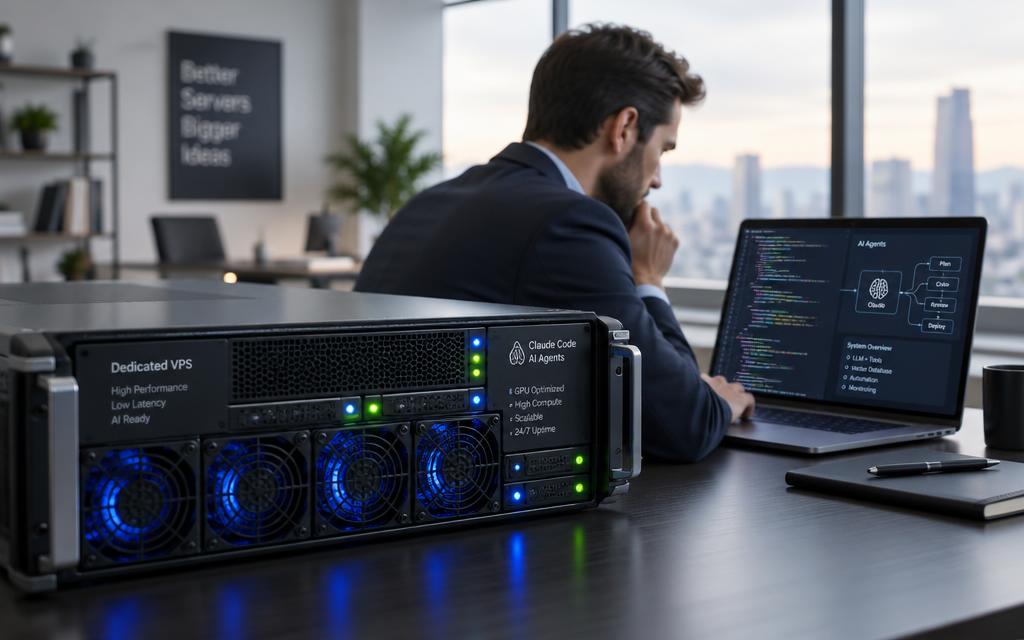
- Remote development with Claude Code via SSH connection.
- Building AI agents with Claude Agent SDK.
- MCP server hosting for connecting Claude to external databases and tools.
- Bots for Slack and Telegram and business automation.
The Model Context Protocol is an open standard that Anthropic launched in November 2024. Those who build AI agents and MCP servers need a stable and always available environment. That is exactly the role of the server.
Benefits of working with Claude on a private cloud infrastructure
Now that we understand what a dedicated server is, it’s worth examining what it actually provides. The benefits of a VPS server are especially noticeable when working with Claude agents who have been running for a long time.
These are the main advantages:
- 24/7 availability : Long-running tasks and background agents continue to run when the PC is turned off.
- Fixed IP : It’s easier to connect Webhooks from GitHub or Slack and add the server to the whitelist.
- Development Environment Isolation : Claude Code runs with broad permissions without putting personal files at risk.
- Access from any device: Connect via SSH from your laptop, tablet, or phone.
- Full control: You choose the versions of Node.js , Python, and any other tools.
- Teamwork: Several developers share one environment with uniform settings.
Cost is an important consideration. With PaaS services like Heroku or Render, the price increases as usage increases. A VPS server offers a fixed, predictable monthly price.
| criterion | Personal computer | VPS server | PaaS service |
|---|---|---|---|
| availability | Only when the computer is on | Continuous, around the clock | Continuous, according to plan |
| IP address | Usually varies | Permanent and dedicated | Common or often variable |
| Isolation from personal files | low | full | full |
| Software and version control | Full | Full | Limited |
| Cost structure | Hardware and electricity | Fixed monthly price | Varies by use |
This combination makes a private cloud infrastructure a solid foundation for AI-powered automation . In the next chapter, we’ll look at what hardware resources are required to get the most out of it.
System requirements and recommended hardware specifications for running Claude
Now that we’ve covered the benefits of private infrastructure, let’s move on to the hardware. The model processing is done on Anthropic’s servers. Your server only sends requests and receives responses, so the requirements are modest.
According to the official documentation, Claude Code system requirements include at least 4GB of memory. In practice, 8GB of server RAM provides a comfortable margin for daily work.
| component | minimum | recommended | Projects with Docker and MCP servers |
|---|---|---|---|
| vCPU processor | 2 cores | 2 to 4 cores | 4 to 8 cores |
| RAM memory | 4GB | 4 to 8GB | 16GB or higher |
| NVMe SSD storage | 20GB | 40 to 80GB | 120GB and above |
| operating system | Ubuntu 20.04 or Debian 10 | Ubuntu 24.04 LTS | Ubuntu 24.04 LTS |
This VPS server specification is suitable for most developers. Databases and multiple concurrent MCP servers will require additional resources.

Claude Code officially supports Ubuntu 20.04 and above and Debian 10 and above. Those who are debating between Ubuntu , Debian, or other Linux distributions can choose Ubuntu 24.04 . It benefits from a large community and security updates until 2029.
Required software components:
- Node.js version 18 or higher, installable via npm
- Git for code version management
- ripgrep for fast file searching
The traffic to the API is text-based and consumes little bandwidth. However, low latency improves the streaming experience. Anthropic servers are located primarily in the US. A server in Europe or the US will shorten response times to the API, which is an important consideration when choosing a provider.
How to choose a VPS server suitable for artificial intelligence projects
After we have defined the hardware specifications, the next step is to choose a VPS provider . This decision has a direct impact on speed, cost, and compliance with legal requirements.
The first question is where the server will be located. This is where latency and regulatory considerations come into play, which are worth considering before anything else.

| criterion | VPS server in Israel | Server in the US or Europe |
|---|---|---|
| Notable suppliers | Kamatera , AWS Tel Aviv region (il-central-1), Google Cloud (me-west1), Azure (Israel Central) | Hetzner , DigitalOcean , Vultr |
| Response time for users in Israel | Very low | Higher |
| Distance from Anthropic API | further | Closer |
| Data retention in Israel | Simple compliance with the requirement | More complex standing |
It’s important to remember: the data sent to Claude is processed outside of Israel, regardless of your server location.
The second question is the level of management. Each option has its own target audience:
- Managed VPS : Includes security updates, backups, and technical support. Suitable for businesses that don’t have a DevOps person.
- Unmanaged VPS : Cheaper and gives full control. Suitable for experienced developers.
The third question is server scalability . A small AI project may grow quickly. Check that the provider offers:
- Upgrade CPU and RAM without reinstalling.
- Hourly pricing.
- Create Snapshots with a click.
- Adding storage volumes as needed.
- API for automating server management.
A provider that meets all of these requirements will save you headaches down the road, and make the Claude installation process much simpler.
Installing and configuring Claude Code and Anthropic API on the server
After you’ve chosen a provider, the practical work begins. Setting up a VPS server properly starts with updating the system. Run apt update && apt upgrade and create a regular user with sudo privileges. Working as root exposes the server to unnecessary risks.
There are two main ways to install Claude Code :
| method | command | Pre-requisite | Version updates |
|---|---|---|---|
| Official installer | curl -fsSL https://claude.ai/install.sh | bash | No additional software needed | Automatic in the background |
| npm | npm install -g @anthropic-ai/claude-code | Node.js version 18 or higher | Manually via npm |
Anthropic currently recommends the official installer. It is simpler and does not depend on the Node environment.
On first run, type claude and choose a login method. You can log in with a Claude Pro or Max subscription. Another option is an Anthropic API Key generated in the Anthropic Console . Store the key in the ANTHROPIC_API_KEY environment variable, not in the code.
Developers building applications can install the Python SDK with the command pip install anthropic . For TypeScript projects, there is the official package @anthropic-ai/sdk .
To keep the server running continuously, it is worth adopting several tools:
- tmux – keeps the session active after disconnecting from SSH.
- systemd – automatically restarts services after a crash or reboot.
- PM2 – Manages Node processes and displays logs in real time.
The final step is to connect external tools. The claude mcp add command adds MCP servers, such as GitHub or databases, and extends the agent’s capabilities. Once the environment is ready, it’s time to secure it.
Server security and API key protection
After installing Claude Code , it’s time to lock down the environment. A leaked API key can generate thousands of dollars in charges within hours. Securing a VPS server starts with proper secret management.
The first rule of API Key protection is simple: don’t store the key in your code or in Git. Store it as an environment variable in your .env file, exclude the file in .gitignore, and limit it to permissions 600. In large organizations, it’s best to use a dedicated tool like HashiCorp Vault or AWS Secrets Manager.
- Create a separate key for each project.
- Change keys regularly.
- Set a monthly spending limit in the Anthropic Console .
The next step is to harden the server itself. These are the main tools:
| component | role | Recommended setting |
|---|---|---|
| SSH hardening | Blocking unauthorized access | SSH keys only, root login disabled, alternate port |
| UFW | Firewall | Opening only the necessary ports |
| Fail2ban | Blocking hacking attempts | Blocking an IP address after multiple failures |
| unattended-upgrades | Security updates | Automatic installation of patches |
| settings.json | Claude Code restriction | Permission for specified commands only |
Always work with a user with minimal privileges, not as root.
On the regulatory side, the Privacy Protection Law and Information Security Regulations of 2017 apply to any database. Amendment 13 , which came into effect in August 2025, granted the Privacy Protection Authority broad enforcement powers. Before sending personal information to Anthropic servers outside of Israel, it is a good idea to perform data de-duplication .
A secure environment is the basis for effective monitoring and ongoing server maintenance.
Performance monitoring and ongoing maintenance of the Claude environment
A secure server is just the beginning. VPS server monitoring helps identify issues before they impact your work with Claude.
For a quick check of CPU, RAM, and disk, the htop tool is sufficient. For continuous monitoring, it is worth installing Netdata , which displays real-time graphs. For large projects, Prometheus collects the data and Grafana displays it in dashboards with alerts.
The Uptime Kuma tool checks the availability of services every few seconds. When something goes down, it sends a notification on Telegram, Slack, or email.
| tool | role | Suitable for |
|---|---|---|
| htop | Manually inspect resources | Speed tests |
| Netdata | Real-time graphs | Single server |
| Prometheus + Grafana | Data collection and alerts | How many servers? |
| Uptime Kuma | Availability monitoring | Any environment |
API usage monitoring is done in the Anthropic Console dashboard. There you can see token consumption and costs by developer. It is important to address two common errors:
- 429 : Account rate limit exceeded.
- 529 : Temporary load on Anthropic’s servers.
The solution is to retry with Exponential Backoff , meaning a wait that gets longer with each attempt. The official Anthropic SDK does this automatically, with two retries by default.
Proper server maintenance is based on regular habits:
- Update Claude Code, Node.js, and system packages.
- Manage logs with journald and logrotate to keep the disk from filling up.
- Daily backups and weekly snapshots with the VPS provider.
- Recovery check once a month. An untested backup is just a promise.
Costs: How much does it cost to run a dedicated VPS for Claude?
Once the server is secured and monitored, it’s worth looking at the bottom line. The total cost is made up of two components: the server itself and the use of the API.
The price of a basic VPS server suitable for running Claude Code ranges from $5 to $25 per month. No graphics card is required, as the model runs on Anthropic’s infrastructure.
- Hetzner : Starting at about 4 to 5 euros per month.
- DigitalOcean : Starting at $6 per month.
- Kamatera : Flexible pricing and data centers in Israel. This is a notable advantage for those looking at the cost of a VPS in Israel .
- AWS and Azure : In the Israeli regions, the price is higher, and in return you receive a set of organizational services.
A managed VPS adds tens of dollars per month, but saves valuable maintenance time.
The second component is Claude API pricing . The charge is determined by a price per token , per million input and output tokens, according to the Anthropic price list at the time of writing:
| model | Input (per million tokens) | Output (per million tokens) | Recommended use |
|---|---|---|---|
| Claude Opus 4.5 | 5 dollars | 25 dollars | Agents and complex missions |
| Claude Sonnet 4.5 | 3 dollars | 15 dollars | Daily code development |
| Claude Haiku 4.5 | 1 dollar | 5 dollars | High-volume, fast-paced tasks |
- Prompt Caching : Reading cached content costs only about 10% of the regular price.
- Batch API : 50% discount on non-urgent tasks.
- Claude Max Subscription : A fixed fee of $100 or $200 per month. The subscription is affordable for heavy Claude Code users.
In summary: a single developer with a $6 server and moderate use of Sonnet can keep monthly expenses low and predictable.
conclusion
The Claude VPS server does not run the model itself. The model runs on Anthropic’s servers. The server’s role is to provide a stable, secure, and 24/7 working environment. In this environment, Claude Code, API calls, and automated AI agents run, independent of the developer’s PC.
The hardware requirements are quite modest. A server with a few cores and basic memory is sufficient for most projects. The server itself is relatively cheap, and the main expense is the consumption of tokens. Regular monitoring of usage helps to keep a predictable and controlled budget.
To build a reliable AI infrastructure , it is important to choose the server location carefully. The location affects response times and how the data is stored. The choice between a managed server and an unmanaged server depends on the technical knowledge of the team. Protecting API keys and complying with the Privacy Protection Act is a must, not a recommendation.
Working with Claude Code in the cloud gives development teams flexibility, control, and time savings. Proper planning, strict security, and ongoing maintenance create an AI solution for businesses in Israel that serves the organization for years.
FAQ
Is it possible to install the Claude model itself on a VPS server?
No. Claude’s model weights are not available for download or local execution , and the model runs only on Anthropic infrastructure. It is accessed via the Anthropic API , Amazon Bedrock , Google Cloud Vertex AI , or Microsoft Foundry . The VPS server acts as a “client” that communicates with the model, and runs the Claude Code, AI agents , MCP servers, and integrations.
Do I need a server with a GPU to work with Claude?
No. All processing is done on Anthropic servers, so a standard virtual server without a graphics card is sufficient. A GPU server is only needed if you run open source models, such as Meta’s Llama or Mistral, in parallel using tools like Ollama.
What is the difference between working at claude.ai and working with Claude on a VPS server?
At claude.ai, work is done in an interactive chat interface in the browser. A VPS server allows for 24/7 automated and continuous running , direct API access, scheduled tasks with cron, agents running in the background, and active Claude Code sessions using tmux , even when the PC is turned off.
How much RAM does a server need to run Claude Code?
Claude Code requires at least 4GB of RAM . For comfortable work, a server with 2 to 4 vCPU cores , 4 to 8GB of RAM , and 40 to 80GB of NVMe SSD storage is recommended. Projects that integrate Docker, databases, or multiple MCP servers at the same time will require additional resources.
What operating system is recommended for a VPS server for Claude?
Claude Code officially supports Ubuntu 20.04 and above and Debian 10 and above . The recommendation is Ubuntu 24.04 LTS due to long-term support and a large community. It can also be worked on a Windows server, but most of the guides, tools and automations in the field are optimized for Linux.
Is a VPS server in Israel or abroad better for working with Claude?
It depends on the need. A server in Israel , for example at Kamatera , AWS (il-central-1 region), Google Cloud (me-west1 region) or Microsoft Azure (Israel Central), provides low response times for local users and eases data retention requirements in Israel. A server in Europe or the US , for example at Hetzner , DigitalOcean or Vultr, is closer to Anthropic’s API. It is important to remember that in either case, the data sent to Claude is processed outside of Israel.
Which is better, managed VPS or unmanaged VPS?
A: Managed VPS includes security updates, backups , and technical support, and is suitable for businesses without a DevOps person. Unmanaged VPS is cheaper and provides full control, and is suitable for developers who are familiar with Linux server management.
How do you install Claude Code on a Linux server?
There are two main ways: the official installer using the curl -fsSL command https://claude.ai/install.sh | bash, or installing via npm with the npm install -g @anthropic-ai/claude-code command after installing Node.js 18 or higher . Then connect with a Claude Pro or Claude Max subscription, or with an API key generated in the Anthropic Console .
How do you keep Claude Code active after disconnecting from SSH?
Use tmux or screen , which keep the session active on the server even after disconnecting, and allow you to return to it from any device. For permanent services, such as bots or MCP servers, it is recommended to manage the processes using systemd or PM2 , so that they are automatically restarted after a crash or reboot.
What is an MCP server and why should you host it on a VPS?
A: MCP (Model Context Protocol) is an open protocol that Anthropic launched in November 2024. It allows Claude to connect to databases, GitHub, Slack, and other external tools. Hosting MCP servers on a VPS ensures that they are continuously available. In Claude Code, they are added using the claude mcp add command.
Can Claude be connected to an automation tool like n8n on the same server?
Yes. You can install open source automation tools like n8n on the VPS, which has built-in integration with Anthropic models, and build business processes that integrate Claude with CRM systems, Gmail, Slack, or Telegram. The server’s fixed IP address makes it easy to receive Webhooks from external systems.
How do you protect the Anthropic API key on the server?
A: Don’t store keys in your code or Git repository. Store them in an .env file excluded in .gitignore with permissions 600, or in a secret management tool like HashiCorp Vault or AWS Secrets Manager . It’s also a good idea to create a separate key for each project, rotate keys regularly, and set spending limits in the Anthropic Console.
How do you secure a VPS server running Claude Code?
Basic steps include logging in using SSH keys only , disabling direct root login, setting up a firewall with UFW , protecting against hacking attempts with Fail2ban , and automatic updates with unattended-upgrades. You can further strengthen security by accessing via a private network like Tailscale , and restricting Claude Code’s permissions in the settings.json file.
Does Anthropic use information sent through the API to train the models?
According to Anthropic’s commercial terms, data sent via the API is not used to train models by default . However, organizations in Israel must comply with the Privacy Protection Law and Information Security Regulations, especially after Amendment 13 comes into effect in August 2025. Therefore, it is recommended to review the transfer of personal information for processing outside of Israel, and consider anonymizing sensitive data before sending it.
What do you do when you receive 429 or 529 errors from the Claude API?
Error 429 indicates a rate limit violation, and error 529 indicates a temporary load on Anthropic servers. The common solution is a retry mechanism with Exponential Backoff , which gradually increases the waiting time between attempts. The official SDK for Python and TypeScript includes a built-in retry mechanism.
How much does it actually cost to run a dedicated VPS for Claude?
A: The cost of the server itself is low , usually around $5 to $25 per month. Hetzner offers servers starting at around $4 to $5, and DigitalOcean starting at $6. The main cost is the consumption of tokens. According to the price list at the time of writing, Claude Sonnet costs around $3 per million tokens per input and around $15 per output, and Claude Haiku 4.5 costs around $1 per input and around $5 per output. Claude Opus prices are higher. It is worth checking the latest price list on the Anthropic website.
How can Claude’s API costs be reduced?
There are several effective ways:
Using Prompt Caching , which significantly reduces the cost of re-reading the persistent context. Using the Message Batches API for non-urgent tasks, at a 50% discount. Choosing a model that is appropriate for the task, such as Haiku for simple tasks and Sonnet or Opus for complex tasks. In addition, it is recommended to monitor consumption in the Anthropic Console control panel. For high-volume Claude Code users, a Claude Max subscription may be more cost-effective than pay-as-you-go.
What tools are recommended for monitoring a server running Claude agents?
To monitor server resources (CPU, RAM, and disk), you can use htop , Netdata , or a combination of Prometheus and Grafana . To monitor service availability , Uptime Kuma is suitable. To manage logs, journald and logrotate are used. In addition, it is important to perform backups and snapshots regularly and check from time to time that the recovery actually works.